 Suno Downloader AI
AI epic music: how to make a huge orchestral sound

Something happens in your chest when the drums hit. The strings climb, a choir opens up behind them, and a wall of low percussion lands like a door slamming in a cathedral. Epic music is built to make you feel bigger than you are, to turn an ordinary moment into the part of the movie where the hero finally stands up. You have heard it under game trailers, sports intros, and the last ninety seconds of every blockbuster. Now you can make your own version of that sound, shape it around your exact scene, and download the finished track to use wherever you need it.
This guide walks through what actually gives epic music its power, the instruments doing the heavy lifting, and how to write prompts that produce a genuinely large sound instead of a thin imitation of one. By the end you will know how to steer an epic music generator toward the moment you are picturing.
What makes music feel epic
Epic is less a genre than a feeling of scale. A gentle piano piece and a stadium anthem can both move you, but only one makes you feel like armies are massing over the next hill. That sense of size comes from a handful of ingredients working together, and once you can name them you can ask for them directly.
The first is contrast. Epic music almost always starts smaller than it ends. A lone instrument, a quiet pulse, a single voice, then layer after layer stacking on top until the full arrangement arrives. The distance between the quiet opening and the loud peak is where the drama lives. If a track is loud the whole way through, your ear stops hearing it as big within about twenty seconds.
The second is register. Epic arrangements spread across an enormous range at once, from a floor-shaking bass rumble to violins singing near the top of their range. Filling that space makes the sound feel physically large, like it is coming from every direction. The third is rhythm with weight. Big, slow, deliberate hits read as powerful, while fast and busy reads as frantic. A slow ostinato under a soaring melody is the classic epic engine.
The last ingredient is a strong, singable melodic idea, usually called the theme. Spectacle without a memorable tune wears out fast. The tune is what people hum on the way out. When you prompt for epic music, think about all four at once: contrast between soft and loud, a wide spread of high and low, weighty rhythm, and a clear main theme.
Key and harmony matter more than people expect. A major key tends to read as triumphant and heroic, the sound of victory and open horizons, while a minor key reads as dark, tense, and dangerous, the sound of a battle you might lose. Many of the best epic cues actually move between the two, starting in shadow and breaking into light at the peak, so the harmony itself tells the story. You do not need to name a specific key in a prompt, but asking for a dark, tense feeling that turns triumphant gives the generator that arc to chase. Tempo plays a similar role. Slower tempos feel weighty and ceremonial, while faster ones feel urgent and driving, so pick the pace that matches whether your scene is a coronation or a chase.
Choir, orchestra, and giant percussion
The classic epic sound leans on three families of instruments, and it helps to understand what each one contributes so you can call for them by name.
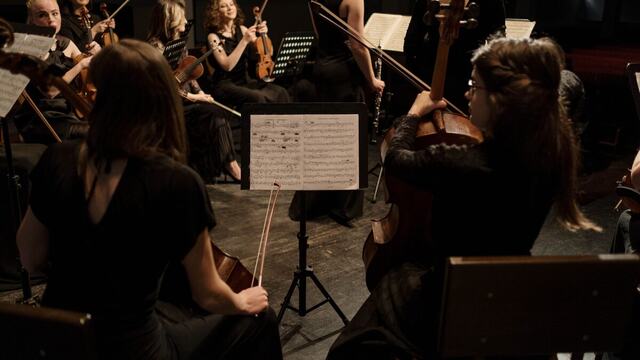
The orchestra is the foundation. Strings carry most of the emotion, with violins taking soaring melodies and cellos and basses laying down the deep, driving lines underneath. Brass brings the heroism. French horns are warm and noble, trumpets are bright and triumphant, and low brass like trombones and tuba add menace and mass. Woodwinds add color and flickers of movement, though they sit further back in an epic mix. When you want grandeur, ask for full strings and heroic brass together.
The choir is what turns big into overwhelming. Human voices carry an emotional charge no instrument matches, and a massed choir singing wordless vowels sounds ancient and enormous at the same time. A high female choir adds shimmer and awe, while a deep male choir chanting adds threat and gravity. Many of the most recognizable trailer moments are just a choir hitting one huge chord under a drum. In a prompt you can ask for an epic choir singing wordless oohs and aahs, or a low men's choir chanting, depending on whether you want beauty or dread.
Percussion is the muscle. Standard orchestral timpani give you tuned booms, but epic music adds a layer of large ensemble drums, sometimes called taiko or cinematic war drums, played by many performers at once. Underneath sits sub-bass, the low frequency hits you feel more than hear. Metallic accents like anvils, cymbal swells, and reversed risers glue sections together and signal that something is about to change. When you want impact, ask for massive cinematic percussion and deep booms on the downbeats.
Ready to build something huge
Describe the choir, the drums, and the hero moment you want, then download your epic track as a clean MP3 or WAV to drop straight into a video.
Open the free downloaderThe build to the hero moment
Almost every memorable epic cue is really a journey from small to overwhelming, and knowing the shape of that journey lets you direct it. Picture the track in four stages.
The intro sets a mood with restraint. One instrument, maybe a solo cello, a lone piano, a distant voice, or a soft pulse. This is the calm that makes the storm hit harder. Keep it sparse and a little mysterious. In a prompt you might describe a quiet, tense opening with a single sustained note and a slow heartbeat pulse.
The build adds layers one at a time. Strings enter low and start climbing, a drum pattern creeps in and grows, and the harmony begins to lean forward as if reaching for something. This section should feel like pressure gathering. The trick is patience. A build that takes its time makes the payoff feel earned. Ask for rising strings, a growing drum pattern, and mounting tension.
The hero moment is the peak, the reason the whole track exists. Everything arrives at once: full orchestra, choir wide open, percussion at maximum, and the main theme stated loud and proud in the brass and high strings. This is the shot where the camera pulls back and the music swells. In a prompt, mark it clearly by asking for a triumphant climax where the full orchestra and choir play the main theme together.
The resolution lets the dust settle. It might be a short, glowing tag on the same theme, or a sudden drop to a single instrument for one last emotional beat. Not every epic track needs a long ending, and for video work a hard, confident finish often works best. Thinking in these four stages, quiet, build, peak, release, gives your prompts a spine and keeps the generator from producing something that is loud but shapeless.
One trick worth stealing from film composers is the false calm before the peak. Just before the biggest moment, they often pull almost everything out, leaving a bar or two of near silence or a single held note. That sudden emptiness makes the full arrangement land twice as hard when it crashes back in, because the ear has nothing to brace against. You can ask for this directly by describing a brief drop to near silence right before the huge climax. It is a small instruction that produces one of the most dramatic effects in the whole style, and it is the difference between a peak that merely arrives and one that feels like a wave breaking over you.
Epic music for games, sports, and hype videos
Epic music earns its keep anywhere you want to make an audience lean forward, and each use has its own flavor worth tuning for.
For game content, epic scoring covers boss fights, cinematic reveals, and menu themes. A boss battle wants relentless, driving percussion and dark, aggressive brass with a choir chanting low. A world-reveal cinematic wants awe, so lean on high strings, a bright choir, and a slower, more majestic tempo. If you stream or make gameplay videos, a custom epic loop under your intro sets the tone before you say a word, and you can download it once and reuse it across every upload.
For sports and hype videos, epic music is the standard fuel. Highlight reels, team intros, and workout montages all ride on the same build-and-payoff structure. Here you often want a faster pulse and a bigger, more modern drum sound, sometimes blended with a rock or electronic edge so it hits harder on phone speakers. Sync the hero moment to the biggest play or the final rep and the whole clip feels professionally scored.
For trailers and announcements, epic music signals importance. A product reveal, a channel trailer, an event teaser, all of them borrow the language of movie trailers to say pay attention, this matters. Keep these tighter and punchier, with clear hit points where the music can land on a cut or a title card. If you are building a full trailer cue, our guide on AI music for trailers: anatomy of a cue breaks down the structure hit point by hit point.
Across all of these, the download step is what makes the music usable. Once you have generated a track you like, save it as an MP3 for quick sharing or a WAV if you plan to edit it against video in an editor. Having the file on your own drive means you can trim it, loop it, and line the peak up exactly where you need it.
Getting a huge sound from prompts
The difference between a thin result and a genuinely large one usually comes down to how specific your prompt is. Vague requests get generic output. Try to name the instruments, the tempo feel, the mood, and the moment you want to build toward.
Start with the core sound. Instead of just asking for epic music, describe the palette: full orchestra, heroic brass, soaring strings, a massed choir, and huge cinematic drums. Add a tempo feeling, such as a slow and powerful march or a driving, urgent pulse. Name a mood, because triumphant, dark, and hopeful all send the generator in different directions. Then point at the shape by mentioning a quiet start that builds to a massive climax.
Reference points help too. Saying trailer music, battle music, or a heroic film score gives the model a strong target without copying any specific work. Keep your own theme in mind so the result feels like yours, and remember that you can generate several versions and pick the one that lands. The table below turns common uses into starting prompts you can adapt.
| What you are scoring | Prompt starting point |
|---|---|
| Game boss fight | Dark epic battle music, aggressive low brass, chanting men's choir, relentless war drums, driving fast tempo, building to a huge climax |
| World reveal cinematic | Majestic epic orchestral music, soaring high strings, bright wordless choir, warm horns, slow and grand, awe and wonder |
| Sports highlight reel | High energy epic hybrid music, big modern drums, powerful strings, driving pulse, triumphant peak on the final beat |
| Channel or product trailer | Cinematic trailer music, tense quiet intro, rising strings and percussion, clear hit points, massive triumphant ending |
| Workout montage | Intense epic motivation music, pounding drums, heroic brass, relentless energy, no let up, big finish |
A few habits sharpen the result. Ask for contrast directly by writing quiet opening that grows into a wall of sound, since that instruction alone fixes the most common problem of a flat, loud-all-through track. Call for both a high and a low element in the same breath, such as deep booming drums under soaring high violins, so the sound fills the whole range. And name the peak, because telling the generator where the climax goes gives the whole piece direction.
Once a version feels right, the emotion becomes clearer with proper scale, so listen on decent speakers or headphones rather than a laptop before you decide. Then download the track and try it against your actual footage. Music that sounds big in isolation sometimes needs a small trim or a different peak placement once it is sitting under a picture, and having the file in hand makes that easy.
It is worth generating more than one version of any epic track. The style depends on so many moving parts, the balance of choir against brass, the exact placement of the peak, the weight of the drums, that two runs of the same prompt can feel quite different in energy. Make a few, listen back to back, and keep the one where the hero moment truly lands. Small wording changes steer the result too. Swapping majestic for aggressive, or wonder for dread, or slow march for driving pulse will noticeably shift the character, so treat your prompt as a set of dials you can turn rather than a single fixed request.
Epic music is one of the most satisfying styles to make because the payoff is so physical. Get the contrast, the range, the weight, and the theme working together, point the build at a clear hero moment, and you end up with something that makes an ordinary clip feel like the end of an adventure. If you want to take the same emotional control into narrative scoring, where the goal is a single scene rather than a wall of spectacle, the next step is scoring by feeling rather than by size.