 Suno Downloader AI
How to make an AI math rock song with Suno
Count to four. Now try counting to seven, then five, then back to seven, while a guitar plays a bright melody that never seems to land where your foot wants to tap. That disorienting, puzzle-box feeling is the heart of math rock. The name is a bit of a joke and a bit of a warning. This is rock music built out of odd time signatures, sudden stops, and interlocking guitar lines that behave more like clockwork than like a jam. Bands like Don Caballero, Hella, and later American Football and Toe made the style a small but devoted world, one where the rhythm is the hook and the cleverness is the point.
Making an AI math rock song is genuinely one of the harder asks you can hand to a music model, and this guide is going to be honest with you about that. The angular riffs and the tapped guitars come out well. The truly weird meters and the split-second stop-start turns are where the technology still strains. So we will walk through what math rock is made of, section by section, and along the way flag exactly where Suno tends to do a great job and where you will need to manage your expectations or work around the limits.
Odd time signatures and angular riffs
The defining feature of math rock is meter that refuses to sit still. Most pop and rock lives comfortably in 4/4, four steady beats to the bar, the pulse you clap along to without thinking. Math rock throws that out. A riff might be in 7/8, so it feels like it trips one beat short every time it comes around. Or it might switch between 5/4 and 4/4 bar by bar, so the ground keeps shifting under you. Some songs stack several meters at once, with the drums counting one pattern and the guitar counting another.
That shifting is what makes the riffs sound angular. Instead of smooth, rounded phrases, you get lines with sharp corners, notes that jab and stop and restart in unexpected places. The melodies are often built from clean, bright, ringing guitar tones rather than heavy distortion, which makes every one of those corners easy to hear. It is intricate, deliberate music that sounds composed rather than felt.
Here is the first honest caveat. Music models like Suno are trained on an enormous amount of 4/4 music, and they have a strong pull back toward that comfortable pulse. If you ask for 7/8, you may get something that feels a little lopsided and interesting, but you may also get a track that quietly straightens itself back into a normal four-count after a bar or two. You can push against this by naming the meter explicitly and by using words like off-kilter, lurching, and asymmetrical, but know going in that the model treats odd meter as a flavor to gesture at rather than a rule to obey precisely.
It helps to understand why odd meter sounds the way it does. A bar of 4/4 divides neatly into two even halves, which is why it feels so stable and easy to march to. A bar of 7/8 cannot be split evenly, so it always feels like it is leaning or limping, resolving one beat too soon. That built-in imbalance is the whole appeal. Math rock bands often group those seven eighth-notes in uneven clusters, say three plus two plus two, and that grouping is what your ear latches onto as the riff. When you write a prompt, you cannot easily specify the grouping, but you can describe the effect, a riff that keeps landing early, a groove that feels like it skips a step, and the model will lean toward that unsettled quality.
Another thing worth knowing is that math rock riffs are usually short and repeated. The complexity comes from the meter and the phrasing, not from constant change, so a good riff might loop many times while your ear slowly works out where the downbeat actually is. That repetition is your friend when prompting, because a music model handles a repeating figure more gracefully than a constantly evolving one. Ask for a hypnotic, repeating angular riff, and you play to both the genre's habits and the tool's strengths at the same time.
Tapping and intricate guitars
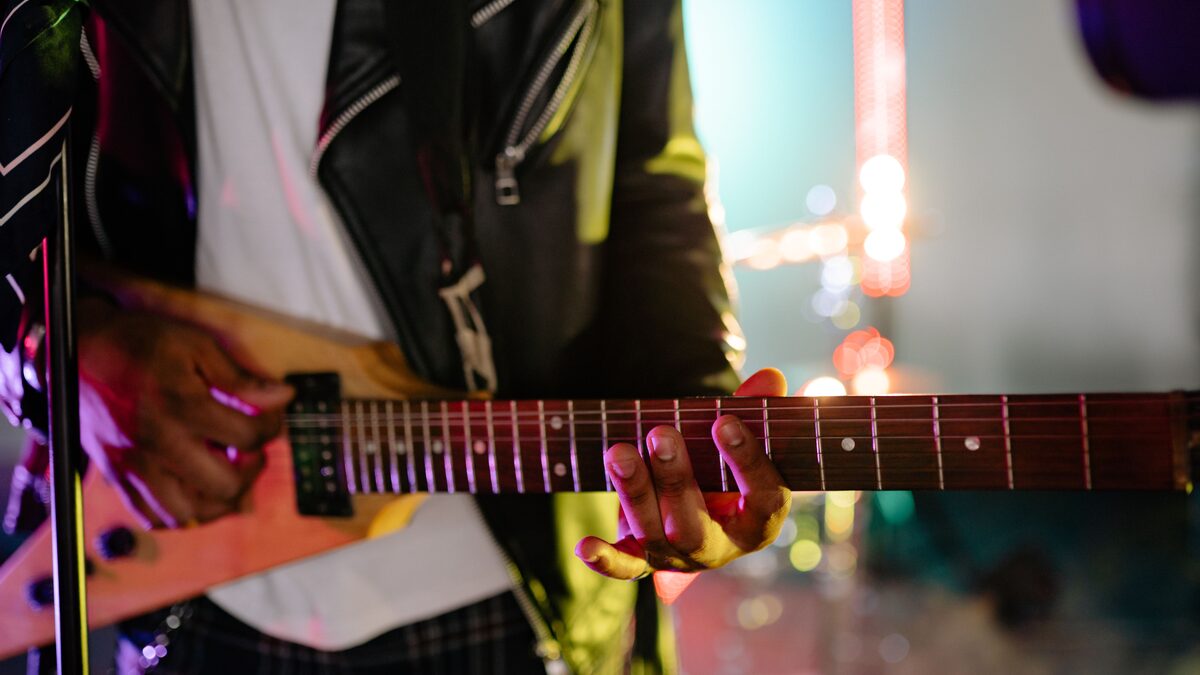
If odd meter is the skeleton of math rock, the guitar technique is the muscle. The signature sound is two-handed tapping, where a player uses fingers on both hands to hammer notes directly onto the fretboard, producing fast, flowing runs that would be awkward to pick. It creates a bright, cascading, almost harp-like effect, and it is everywhere in the genre. Alongside tapping you get finger-picked arpeggios, unusual chord voicings full of open strings, and guitars tuned to strange alternate tunings that give the whole thing a shimmering, bell-like ring.
The interplay is key. Math rock usually has two guitars, and they weave around each other, each playing a different pattern that locks together into a single moving mesh. One might hold a repeating figure while the other climbs over the top. This counterpoint, closer to how a Bach piece is built than to a standard rock song, is a big part of why the style feels so intricate and mathematical.
Good news on this front: this is where AI does well. Suno is quite happy to produce bright, clean, tapped and finger-picked guitar textures, and it can layer interlocking parts that genuinely sound like two players trading lines. If you ask for cascading tapped guitars, ringing open strings, and intricate finger-picked patterns, you will usually get something convincing. The timbre and the busyness come across even when the underlying meter does not. So lean into the guitar description. It is the part of the prompt most likely to pay off exactly as you imagine.
The tone you ask for shapes how mathy the result feels. A warm, clean, slightly reverbed guitar with plenty of ringing open notes reads instantly as the emo-leaning, twinkly end of math rock. A brighter, more clinical tone with tighter notes reads as the sharper, more technical end. Distortion, meanwhile, pulls you toward the metal cousins, so if you want the classic bright math rock sparkle, be explicit that the guitars are clean and undistorted. Small tonal words like glassy, chiming, and bell-like do a surprising amount of work in pointing the model at the right corner of guitar sound.
It is also worth asking for the guitars to sit forward in the mix, because in math rock the guitars are the lead voice, the melody, and the rhythm all at once. There is rarely a big vocal or a wall of synths to compete with them. A track described as guitar-forward, with the interlocking parts loud and detailed and the rest of the band supporting underneath, will come back sounding far more like the genre than one where the guitars are buried. Give them the spotlight in your description, because that is exactly where a real math rock band puts them.
The stop-start dynamics
Math rock does not flow so much as it lurches and leaps. One of its most recognizable traits is the sudden stop: the whole band cutting out at once, leaving a beat of silence, then slamming back in on an unexpected count. There are hairpin turns, sections that change tempo or feel with no warning, quiet passages that erupt into loud ones and then snap back. The dynamics are jagged by design. The music keeps you off balance because it is constantly starting and stopping.
These abrupt shifts are tied to the odd meters. A stop that lands on the seventh beat of a 7/8 bar feels jarring in exactly the way the genre loves. The rhythmic tension builds up and then gets released in a burst, and the tight, in-the-pocket execution of those stops is a mark of a good math rock band. When everyone hits the silence and the return at precisely the same moment, it sounds thrilling. When they miss, it just sounds sloppy.
These dynamics are also what give math rock its sense of humor. There is something playful about a band that slams to a halt just to make you flinch, then bursts back in as if nothing happened. The best math rock does not take itself too seriously, and the stop-start writing is where that wink lives. Even if you cannot control the exact placement of a stop, you can ask for a playful, surprising arrangement full of sudden turns, and the model will tend to introduce more contrast and more unexpected shifts than it would for a straightforward rock song.
And here is the second honest caveat. Precise, band-wide stop-start hits are hard for a music model to nail. Suno can give you dynamic contrast, loud sections and quiet sections, builds and drops, and it can suggest the stop-start feeling. What it struggles with is the surgical precision of a full stop landing on an unusual beat and the whole arrangement snapping back in perfect lockstep. You can ask for sudden stops, abrupt dynamic shifts, and start-stop rhythms, and you will get gestures toward that energy. Expect the flavor, not the millimeter-perfect execution a human band would deliver.
Math rock and its cousins
Math rock does not exist alone. It grew up alongside several related styles, and understanding the family helps you aim your prompt more precisely, because the differences are often a matter of degree. Post rock, for instance, shares the clean guitars and the instrumental focus, but it trades math rock's jittery complexity for long, patient builds and washes of sound. It is the calmer, more cinematic cousin.
Then there is midwest emo, which took math rock's tapped, twinkly guitars and paired them with heartfelt, sometimes wobbly vocals about growing up. It is warmer and more emotional, less concerned with showing off the meter. At the heavier end sits math metal, or djent-adjacent progressive metal, which keeps the odd time signatures but adds crushing distortion and aggression. And then there is straightforward prog, which shares the love of complex structure but tends toward longer, more grandiose compositions.
Knowing where you are aiming changes your words. The table below sorts the neighbors so you can steer toward the exact corner you want.
| Style | Feel and how to steer it |
|---|---|
| Math rock | Bright, clean, angular; odd meters and tapped guitars; ask for intricate, off-kilter, start-stop |
| Post rock | Slow, cinematic builds; clean guitars but patient; ask for atmospheric, swelling, instrumental |
| Midwest emo | Twinkly guitars plus emotional vocals; ask for heartfelt, warm, tapped and jangly |
| Math metal | Odd meters with heavy distortion; ask for aggressive, palm-muted, technical and crushing |
Turn the count into a track
Generate your math rock idea, then keep a copy of the take that comes closest.
Open the free downloaderGetting a complex feel from prompts (and where AI struggles)
Time to put it together and be practical about it. The smart way to prompt for math rock is to play to the model's strengths and describe the weaknesses in a way that still gives you something usable. Spend most of your prompt on the guitar sound, because that is what comes out best. Ask for bright, clean, ringing electric guitars, two-handed tapping, cascading arpeggios, and interlocking finger-picked patterns. Load up on that detail and the track will already sound like math rock on the surface.
For the rhythm, name the meter but do not expect obedience. Say 7/8 or 5/4, and back it up with feel words the model understands better: off-kilter, lurching, asymmetrical, jittery, restless. These adjectives push the drums toward busier, less predictable patterns even when the strict count slips. Think of the meter number as a suggestion and the feel words as the real instruction. The combination gets you closer than either alone.
For the dynamics, ask for what you can actually get: sudden stops, abrupt shifts between loud and quiet, tempo changes, jagged energy. You will get contrast and surprise, which reads as math rock even if the stops are not surgically placed. And keep the whole thing instrumental unless you specifically want the midwest emo flavor, because math rock is often wordless and the vocals can pull the model back toward more conventional song structures.
Now the candid part, gathered in one place so you can plan around it. Odd meters will often soften back toward 4/4. Precise band-wide stops will blur. Very long, through-composed structures with no repeating chorus are hard for the model to hold together, so you may get more repetition than a real math rock band would use. None of this means the exercise fails. It means you should generate several takes, listen for the one with the most convincing angular energy, and download that version so you have it locked in before you tweak the prompt again. Treat it as a collaboration where you supply the taste and the model supplies the texture.
| What you want | Prompt language to try |
|---|---|
| Angular riffs | "instrumental math rock, angular off-kilter riffs, asymmetrical phrasing, restless and jittery feel" |
| Tapped guitars | "bright clean electric guitars, two-handed tapping, cascading arpeggios, ringing open-string chords" |
| Interlocking parts | "two guitars weaving interlocking finger-picked patterns, counterpoint, intricate and mathematical" |
| Odd meter feel | "lurching 7/8 groove, shifting time, drums that trip and restart, lopsided and unpredictable" |
| Stop-start dynamics | "sudden full-band stops, abrupt loud-quiet shifts, tempo changes, jagged start-stop energy" |
The honest conclusion is that math rock sits right at the edge of what these tools do comfortably, and that is part of the fun. You are asking a model built for steady grooves to trip and stagger on purpose, and it will fight you a little. But the guitar textures come out genuinely well, the busy energy translates, and with enough takes you can land something that has the bright, tangled, clever character the genre is loved for. Prompt hard on the guitars, gesture firmly at the meter, ask for the jagged dynamics, and pick the take with the most convincing lurch. It will not be a note-perfect transcription of a Don Caballero record, but it can absolutely capture the spirit, and that spirit is what makes math rock worth chasing in the first place.