 Suno Downloader AI
A short history of AI music, from early machines to today
Type a few words, wait a moment, and a finished song plays back at you. To most people this arrived out of nowhere, a trick that simply did not exist one year and was everywhere the next. It feels sudden, and in the sense of everyday access it genuinely is. But the story behind that little text box is much longer than the recent noise suggests. People have been trying to get machines to make music for the better part of a century, and the modern tools sit at the end of a long chain of experiments, dead ends, and slow breakthroughs. Understanding that chain makes today's tools less magical and, oddly, more impressive.
This is a tour through that history. We will keep the dates general where the details are fuzzy, because the point is the shape of the journey rather than a quiz on exact years. What matters is how each era set up the next, and how a string of separate ideas eventually converged into something you can now use from your phone.
Early experiments and algorithmic composition
The idea that music could be generated by following rules is far older than the computer. For centuries, composers played with systems, formulas, and games of chance that turned a set of instructions into a piece of music. There were dice games that assembled short musical fragments into a finished minuet depending on the roll, letting anyone produce a passable composition without writing a note themselves. That impulse, to capture the logic of music as a set of steps a machine or a procedure could carry out, is the seed of everything that followed.
When the first computers appeared in the middle of the last century, a handful of curious researchers and composers immediately wondered whether these calculating machines could compose. They wrote programs that applied the rules of harmony and melody, then let the machine work through them to produce scores. The results were often stiff and academic, more proof of concept than music you would choose to listen to, but the principle was established. A machine could be handed the grammar of music and asked to generate something new within it. In those early decades, composition by rule was mostly a scholarly pursuit, tucked away in universities, but the door had been opened.
What is striking about this era is how much of it was about understanding music rather than mass-producing it. The pioneers were asking what music is made of, whether its patterns could be written down as procedures, and what happened when a machine followed those procedures without a human ear guiding every choice. Those questions never really went away. They just kept coming back in more powerful forms.
It is worth pausing on why the early results sounded so mechanical. When you spell out the rules of harmony as strict instructions, a machine follows them literally, with none of the small deviations a human player makes without thinking. Music that is technically correct can still feel lifeless, and the gap between correct and moving is exactly the thing these early systems could not cross. That gap became the quiet theme of the whole history that followed. Every later advance was, in one way or another, an attempt to close it, to get a machine to capture not just the rules of music but the feel underneath them.
Computers and MIDI
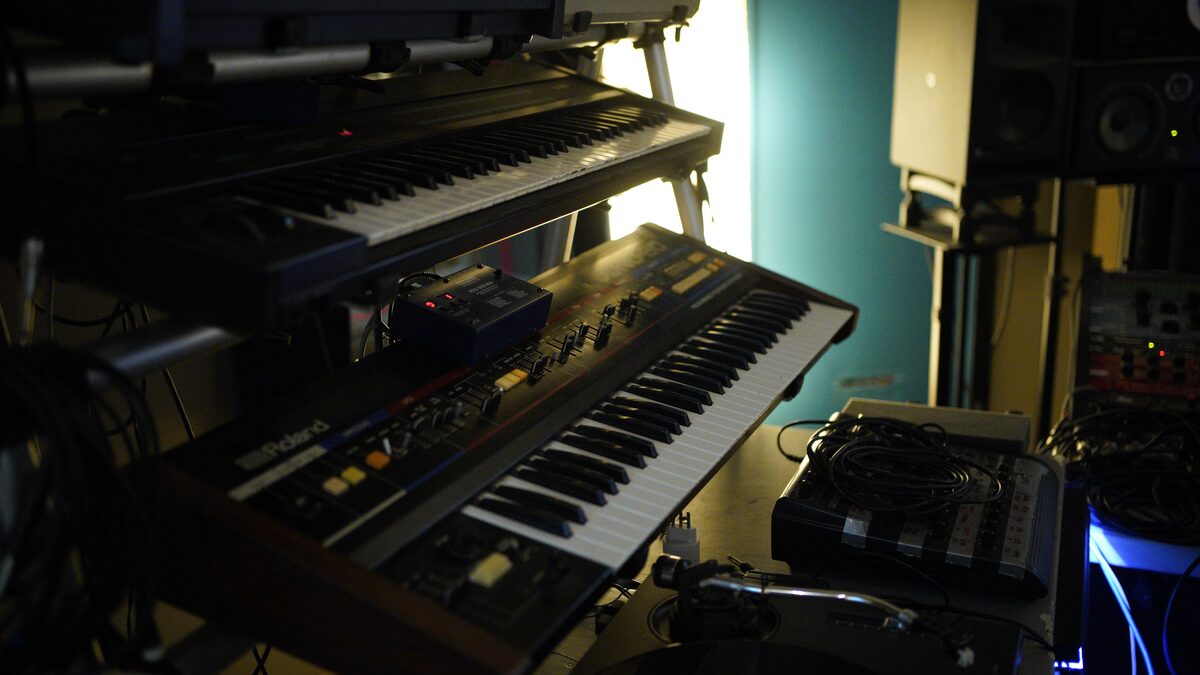
For a long stretch, the machine's role in music was less about composing and more about control. As electronic instruments spread, musicians needed a way for their gear to talk to itself, for a keyboard to trigger a synthesizer, or for a sequence of notes to play back automatically. A shared standard emerged that let instruments and computers exchange performance information, describing which note to play, how hard, and for how long, rather than the sound itself.
This changed the everyday practice of making music more than any composing program had. Suddenly a single person at a desk could arrange, layer, and edit parts that once needed a room full of players. Notes became data you could move around, correct, and rearrange endlessly. The computer had become the studio's central nervous system. It was not making creative decisions on its own, but it was handling music as structured information, and that framing turned out to matter enormously later.
Alongside this, software that could arrange and generate patterns grew more capable. Programs could improvise within a style, fill in accompaniment, or spin variations on a theme. Some of it leaned on rules, some on randomness shaped by a composer's constraints. None of it sounded like a person had written it, exactly, but the tools were learning to take on more of the busywork. The line between a machine that stores your music and a machine that helps create it started to blur. Still, everything so far worked from instructions a human had written down. The machine did not know anything about music that a person had not told it.
This period also quietly democratized music-making in a way that is easy to overlook now. Home studios became possible on ordinary computers, and a generation of musicians grew up arranging entire productions in software without ever booking studio time. The machine was not creative, but it lowered the cost and effort of turning an idea into a finished piece, and that lowering of the barrier is a pattern that repeats right up to the present. Every time the tools got easier, more people made music, and the range of who could take part widened.
The machine-learning turn
The next shift changed that completely. Instead of programming the rules of music by hand, researchers began building systems that could learn patterns from examples. Feed a model a large collection of melodies, and rather than being told the rules of harmony, it would infer them from what it saw. This is the machine-learning turn, and it quietly rewired the whole endeavor.
Early versions of this were modest. Models learned to predict the next note in a sequence, producing short passages that sometimes captured the feel of a style and often wandered off into nonsense. But the underlying idea was powerful. A system that learns from data can pick up subtleties that no one would think to write into a rulebook, the small habits and tendencies that make a genre sound like itself. As the models grew and the pools of training music grew with them, the outputs got more coherent, holding a musical thought together for longer stretches.
A useful way to picture the difference is to imagine two ways of teaching someone to cook. The old approach handed the machine a fixed recipe and told it to follow every step exactly. The new approach let the machine taste thousands of dishes and work out for itself what tended to go together. The second method is messier and harder to control, but it captures things a written recipe never could, the intuition that comes from exposure rather than instruction. That is roughly the leap that machine learning brought to music, and it is why the outputs began to feel less like exercises and more like attempts.
This era was mostly happening in research labs and among technically minded artists. The tools were not friendly, the results were uneven, and you needed real expertise to get anything out of them. But a crucial threshold had been crossed. Machines were no longer just following human instructions about music. They were forming their own internal sense of what music tends to do, learned from listening, in a loose sense, to a great deal of it. Everything that came next was a matter of scaling that idea up and pointing it at raw sound.
The generative-audio breakthrough
For most of the history so far, machines worked with music as symbols, notes and instructions, not as actual sound. A program might arrange a convincing sequence, but turning that into a finished recording still needed instruments, samples, and a human touch. The breakthrough that defines the current moment was teaching models to generate the audio itself, the raw waveform, complete with the texture of a voice, the grain of an instrument, and the space of a room.
This was a much harder problem than generating notes. Sound is dense and detailed, with thousands of tiny values every second, and making it coherent over the length of a whole song is a serious challenge. As techniques improved and the models grew large, systems began producing audio that held together, first in short clips, then in longer passages, and eventually in complete songs with structure, vocals, and production. The gap between a symbolic sketch and a finished-sounding record started to close.
Vocals deserve a special mention here, because they were long considered one of the hardest parts. A synthesized voice that sounds convincingly human, with breath, phrasing, and expression, is a tall order, and for years machine-made singing landed somewhere between charming and unsettling. The recent tools crossed a threshold where generated vocals can sit inside a song without immediately announcing themselves as artificial. That single advance did a lot to make the outputs feel like real songs rather than instrumentals with a robot on top, and it is a big part of why the current wave caught on so widely.
The other half of the breakthrough was the interface. Powerful models are only as useful as the way people reach them, and the decisive step was wrapping all this capability in something anyone could operate: a text box. Describe the song you want in plain language, and the system handles the rest. That combination, generative audio behind a simple prompt, is what turned a laboratory capability into a tool millions of people could pick up without any musical training at all. Once a song existed as a file you could play, share, and download, music generation stopped being a research demo and became a thing people actually do.
Where we are now
That brings us to today, where making a song is roughly as easy as writing a sentence. You describe a mood, a genre, a theme, maybe a few lyrics, and within moments you have something to listen to. You can keep the takes you like, save them to your own device, and build on them. Tools like Suno sit at the front of this wave, and the barrier that once separated people with musical training from everyone else has largely dropped away. If you are curious about how one of these systems works under the hood, our explainer on Suno AI and how it works walks through the practical side.
The change in who gets to make music is the part most worth sitting with. For most of the history in this story, creating a finished song required years of training, access to instruments or a studio, and usually collaborators. Each era chipped away at those requirements, and the current one has knocked out most of them at once. Someone with a melody in their head and no way to play it can now hear a version of it in minutes. That does not replace the craft of trained musicians, and it does not pretend to. It simply means the front door to making music is wider open than it has ever been, which is either thrilling or unsettling depending on where you stand, and honestly a bit of both.
What is worth noticing is how much of the old history lives inside the new tools. The dream of composing by rule, the treatment of music as structured data, the shift to learning from examples, the leap to generating raw sound: none of these was discarded. They stacked. Each era solved a piece of the puzzle and handed it forward. The text box that feels so sudden is really the visible tip of a century of accumulated work, most of it invisible to the person typing a prompt.
It is also an unfinished story. The current tools are remarkable and genuinely limited at the same time. They can produce a catchy, listenable song and still stumble on the things a skilled human handles instinctively, the deliberate imperfection, the emotional arc, the choice to break a rule for effect. We are somewhere in the middle of the arc, not at its end, and the pace of change makes any confident prediction risky. For a grounded look at where this might head, our piece on the future of AI music tries to stay measured rather than breathless.
The honest summary is that AI music did not appear overnight, even though using it now takes seconds. It grew out of a long line of people asking the same stubborn question in different ways: can a machine make music, and what does it teach us about music when it tries? Each generation answered a little more of that question. The tools you can open today are the current answer, and given the history, they will not be the last one. If the past is any guide, the next chapter will make some part of today's process feel clumsy in hindsight, the way early home-studio software looks quaint next to a modern phone app. That is the nature of this particular road. Each stop feels like the destination until the next one arrives. If nothing else, knowing the road that led here makes the thing in front of you easier to appreciate, and easier to use with clear eyes about what it can and cannot yet do.
Be part of the latest chapter
The tools took a century to arrive. Try one for yourself, keep the songs you like, and save a copy to your own device in seconds.
Open the free downloader