 Suno Downloader AI
AI swing music: making that dancing rhythm with Suno
Put on a record from 1938 and watch what happens to a room. Feet start tapping before anyone decides to move. Shoulders sway. Somebody grins. Swing music does that. It has a pulse that reaches past your ears and grabs your body, a rhythm built for the dance floor and nothing else. That bounce, that lift on every second beat, is the whole reason the music exists. Before the recording gear, before the arrangements, before the horns even come in, there is the swing itself.
That feel is exactly what makes swing a fun and tricky thing to build with an AI music tool. Suno can hand you a big band in seconds, complete with roaring brass and a walking bass line. But whether it truly swings, whether it has that irresistible bounce, depends a lot on how you ask. This guide walks through the sound piece by piece and shows you how to write prompts that dance instead of march. And once you have a take you love, you can save the MP3 and drop it into a playlist, a video, or a dance class warmup.
That swinging rhythm
Everything about swing starts with the rhythm. A straight beat divides each pulse into two even halves, tick-tick, tick-tick. Swing does something different. It stretches the first half of each pair and shortens the second, so the rhythm goes long-short, long-short, a loping gait that feels like a skip in every step. Musicians call it a triplet feel or a shuffle. You do not need to know the theory to hear it. You already know it. It is the difference between a clock and a heartbeat.
This is the single most important thing to get right, and it is where a lot of AI attempts fall flat. If your prompt only says "1940s jazz," you might get something that sounds vintage but plods along on a stiff, even beat. The magic is in the bounce, so you have to name it. Words like "swung eighth notes," "shuffle rhythm," "bouncing swing feel," and "triplet groove" push the model toward that loping motion. Adding a tempo helps too. Classic dance swing sits in a lively middle range, quick enough to move to but not a breathless sprint.
Try describing the effect on the listener, not just the technique. "A rhythm that makes you want to dance" or "an infectious, toe-tapping bounce" gives the model an emotional target. When the groove lands, you feel it in the first two bars. When it does not, no amount of good horn writing will save the track, so this is the part worth regenerating until it clicks.
It also helps to think about where the accents fall. Swing puts weight on the offbeats, the ands between the main pulses, which is part of why it feels like it lifts rather than stomps. A march hits hard on one and three, flat and even. Swing leans into two and four and floats between them. You do not need to spell out the counting in a prompt, but you can gesture at the feel with words like "light on its feet," "buoyant," and "with a lift on the offbeat." Those cues nudge the model away from a heavy, plodding read and toward the airy motion that makes swing feel like it could take off.
The big band and the horns
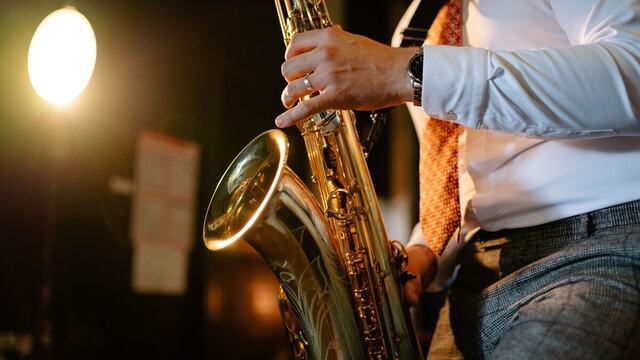
Once the rhythm is right, the horns are what make swing sound like swing. A full big band stacks brass and reeds into sections that answer each other back and forth. Trumpets bark out bright, punchy figures up top. Trombones fill the middle with warmth and the occasional growl. Saxophones, usually a whole section of them, carry the smooth melodic lines and the lush harmony underneath. When all of it hits together on a big accented chord, you get that wall of sound that makes the hair on your arms stand up.
In your prompts, be specific about the instrumentation. "Full big band with brass and reed sections," "punchy trumpet stabs," "warm trombone lines," and "a rich saxophone section" all steer the arrangement toward that classic layered sound. You can also call out the call-and-response between sections, a defining feature of the style. Try "brass and saxophones trading phrases" or "horn sections answering each other." That back-and-forth is a big part of what makes a big band chart feel alive and conversational rather than static.
Dynamics matter here more than in most genres. Great swing arrangements breathe. They drop down to a whisper for a verse, then build to a shouting climax on the final chorus. Prompt words like "dynamic arrangement," "building to a big finish," and "soft verses with an explosive chorus" encourage the model to shape the energy across the track instead of blasting at full volume the whole way through.
There is also the matter of the riff, the short repeated horn phrase that a section plays behind a soloist or a vocal. These little figures are the glue of big band writing. They give the ear something to hold onto and build tension as they repeat and climb. If you want that classic layered feel, ask for "repeating horn riffs behind the melody" or "brass riffs building under the solo." It is a small request that pays off, because those riffs are a big part of why a full band sounds so much richer than a single instrument playing the same tune.
Ready to hear your own big band?
Generate a swing track in Suno, then keep the take that bounces. Save it as an MP3 in a couple of clicks and it is yours for playlists, videos, or the dance floor.
Open the free downloaderThe walking bass and the ride cymbal
Under all that brass, two instruments quietly run the whole show: the bass and the drums. The bass in swing does not just hold down the root note. It walks. A walking bass line steps steadily up and down through the chords, one note per beat, tying everything together with a smooth, rolling motion. It is the connective tissue of the groove, the thing that keeps the band moving forward even when the horns pause for breath. Ask for "a walking bass line" or "steady walking upright bass" and you give the track its forward pull.
The drums have their own signature. The heart of a swing drum kit is the ride cymbal, played with that unmistakable ding-ding-a-ding pattern that states the swing rhythm out loud. The hi-hat clicks shut on the backbeat, the snare adds little accents and kicks, and the bass drum stays light, often just feathering underneath. It is a busy, springy style of drumming that pushes the dancers along. Try "swinging ride cymbal pattern," "brushes on the snare" for a softer number, or "driving swing drums" for something hotter.
The interplay between the walking bass and the ride cymbal is the engine room of swing. When those two lock together, the whole thing floats. In your prompts, you can name both at once, something like "walking upright bass locked in with a swinging ride cymbal," to make sure the rhythm section is pulling in the same direction. Get that pairing right and the horns have a solid, springy floor to dance on.
Piano and guitar round out the rhythm section, and each has a role worth knowing. The pianist often plays little stabbed chords in the gaps, a technique that punctuates the groove without cluttering it. The guitar, in older styles, strums a steady chord on every beat, a quiet chugging that adds drive you feel more than hear. Ask for "comping piano" or "steady four-to-the-bar rhythm guitar" if you want that fuller texture. These parts sit low in the mix, but take them away and the band loses some of its forward motion and its springiness, so they are worth requesting even though few listeners could name them.
Swing, big band, gypsy jazz
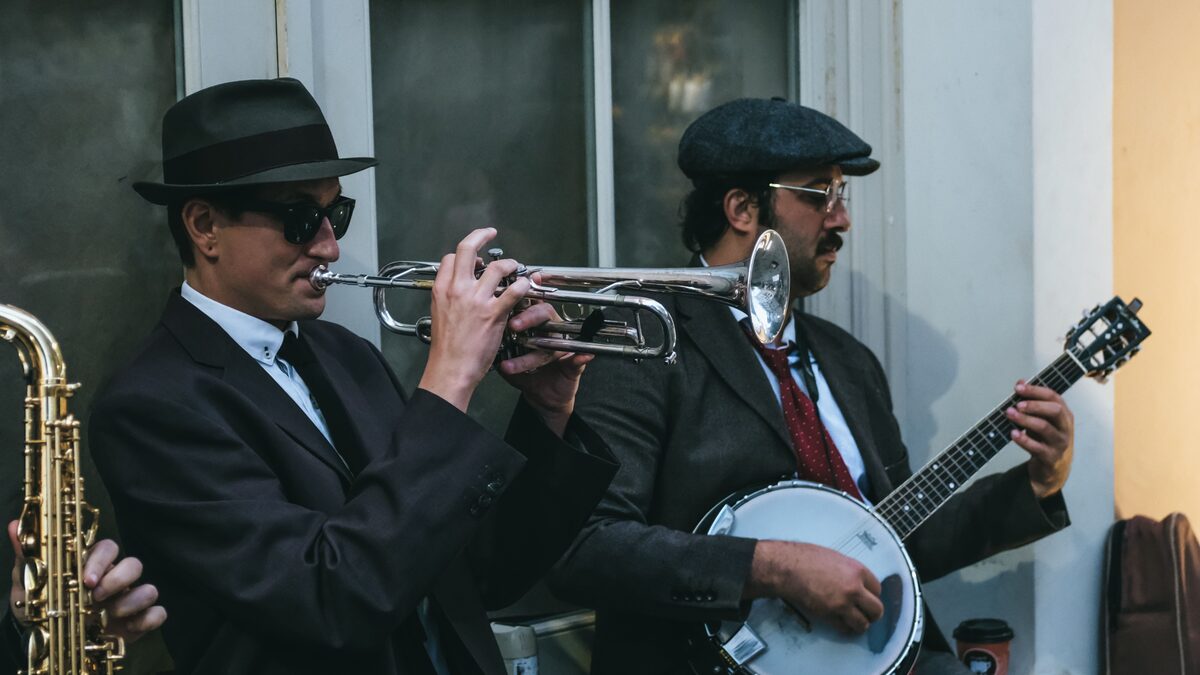
Swing is a wide world, and a few words in your prompt can send you to very different corners of it. It helps to know what you are actually asking for. The big band sound of the 1930s and 40s is the one most people picture, all glamour and horns and ballrooms. But there is also small-group swing, a leaner sound built around a handful of players trading solos in a club. And then there is gypsy jazz, a distinct offshoot driven by acoustic guitars and violin instead of horns, with a fast, fiery strumming rhythm all its own.
Each of these has a different texture, so naming the right one saves you a lot of wasted takes. The table below lays out a few styles under the swing umbrella and the prompt language that tends to land each one. Think of it as a starting menu rather than a strict rulebook. The fun part of an AI tool is that you can blend these freely, asking for a gypsy jazz rhythm section under a big band horn arrangement if the mood strikes.
| Swing style | Prompt language that works |
|---|---|
| Big band swing | "1940s big band, full brass and reed sections, punchy horns, ballroom energy, swung rhythm" |
| Small-group swing | "small swing combo, upright bass, brushed drums, trading solos, intimate club feel" |
| Gypsy jazz | "gypsy jazz, fast acoustic guitar strumming, violin lead, upright bass, hot club sound" |
| Jump blues | "jump blues, honking saxophone, boogie piano, shuffle rhythm, party energy" |
| Vocal swing | "swing ballad with a crooner vocal, lush horns, brushed drums, romantic mood" |
Notice how each row names both the instruments and the feel. That combination is what keeps the model from wandering. If you only say "gypsy jazz," you might get horns anyway, but pairing it with "acoustic guitar strumming" and "violin lead" anchors it in the right sound. The same trick works across the whole family.
Tempo is the other big lever between these styles. A slow vocal swing ballad and a frantic jump blues both swing, but they live at opposite ends of the speed range, and that speed changes everything about the mood. Slow swing is romantic and roomy, with space between the notes. Fast swing is a jolt of pure adrenaline that leaves the dancers breathless. When you pick a row from the table, think about the tempo you actually want and name it, because the same instrumentation can feel completely different at a stroll versus a sprint. Getting the speed right up front saves you from a stack of takes that have the sound but the wrong energy.
Getting that bounce from prompts
Now let us put it all together into a way of writing prompts that actually swings. The best swing prompts stack three things: the rhythm feel, the instrumentation, and the mood. Miss any one and the track leans in the wrong direction. Lead with the bounce, because that is the part the model most often gets wrong. Something like "upbeat swing with a strong swung rhythm and an infectious bounce" sets the foundation before you name a single instrument.
Next, layer in the band. Add your horn sections, your walking bass, your swinging ride cymbal. Be as specific as your ear wants to be. If you love a growling trumpet solo, ask for one. If you want the saxophones to carry the melody, say so. The more clearly you picture the arrangement, the closer the result lands. Then finish with mood and setting. "Glamorous 1940s ballroom," "smoky late-night club," or "a joyful, celebratory party" all color the performance in ways pure technical description cannot.
Vocals, if you want them, open another door. Swing has a rich tradition of crooners and belters singing over the band, phrasing loosely and playing with the rhythm the way an instrumentalist would. A swing vocal does not sit rigidly on the beat. It leans behind it and pushes ahead of it, relaxed and conversational. If you are writing a vocal number, prompt for "a smooth crooner phrasing behind the beat" or "a playful, swinging vocal" and give your singer room to breathe. Lyrics in this world tend toward romance, nightlife, and easy charm, so keep them light and let the mood match the bounce underneath.
A word on structure. Swing tunes often follow a clear arc: a stated melody, a series of solos where different instruments step forward, and a final chorus where the whole band shouts together. You can guide this with lyric or structure tags, marking a section for a "trumpet solo" or a "big band shout chorus." Even if you are making an instrumental, giving the arrangement somewhere to go keeps it from feeling like the same eight bars looped over and over.
Finally, do not settle on the first take. Swing lives or dies on feel, and feel is exactly the thing that varies most between generations. Run your prompt a few times. One take will plod, another will merely be fine, and then one will hit that bounce and make you grin. That is the keeper. When you find it, download the MP3 right away so you do not lose it. A track that truly swings is worth holding onto, whether you made it for a dance class, a vintage-themed video, or just the pleasure of hearing a big band you conjured from a sentence.
The thing to remember through all of it is that swing is physical music. It was built to move bodies across a floor, and every choice in your prompt should serve that goal. When you write for the dancer instead of the listener sitting still, the rhythm comes alive, the horns start to talk, and the bass walks you right into the next chorus. Get the bounce right, and everything else follows.